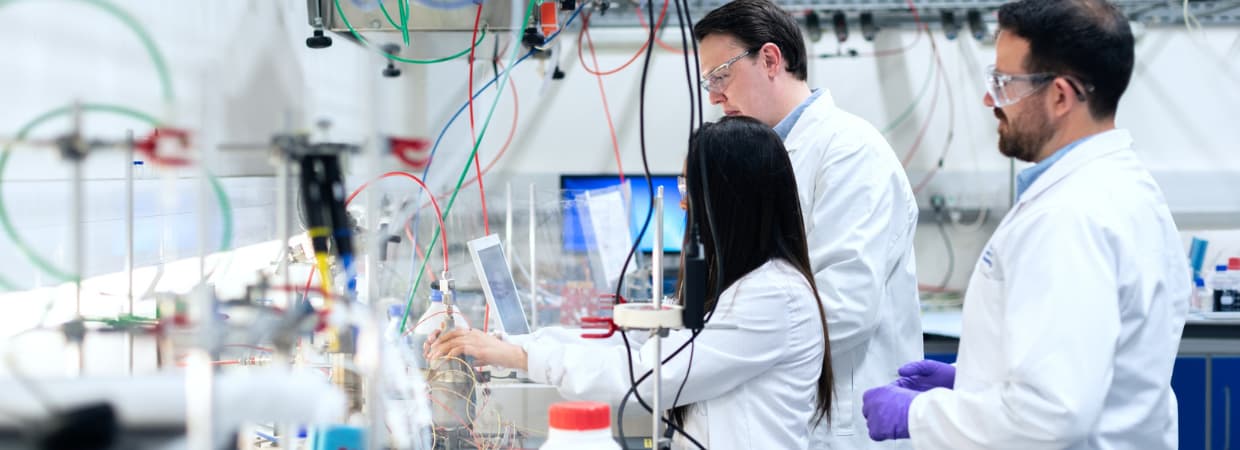
Laboratories are unlike any other working environment. They demand technical accuracy, regulatory compliance and carefully controlled conditions, all while supporting the people driving innovation within them.
A successful laboratory fit out is not simply about installing benches and services. It is about creating a space that enables scientific progress, protects staff, supports operational efficiency and adapts as research evolves.
At COEL, we take a future view. We work closely with scientific teams, estates managers and leadership groups to align spatial design with research objectives, funding cycles and growth plans. The result is a laboratory environment that performs from day one and remains resilient as requirements change.
Below are the considerations that shape a modern laboratory fit out.
Every successful laboratory begins with planning. Before design concepts are developed, it is essential to understand workflow, adjacencies and operational priorities.
Mapping the journey of people, samples and equipment through the space helps reduce inefficiencies and risk. Separating clean and dirty processes, defining write-up areas, and ensuring logical storage locations all contribute to a safer, more productive environment.
Stakeholder engagement is equally important. Early consultation with researchers, facilities teams and compliance leads ensures the space reflects both scientific needs and commercial realities. Planning for future headcount growth and evolving research programmes protects the value of the investment.
Laboratories rely heavily on robust and resilient electrical systems. Specialist equipment, environmental controls and data infrastructure create significant load demands that must be carefully calculated at the design stage.
Provision for clean power supplies may be required to protect sensitive instrumentation. Critical equipment often benefits from UPS systems or generator backup connections to maintain continuity during outages. In high-value research environments, even a short interruption can have serious consequences.
Energy monitoring systems are increasingly integrated to track usage and support sustainability targets. Designing with future capacity in mind avoids costly upgrades later and ensures the laboratory can accommodate new technologies as research advances.
All installations must meet current British Standards and be delivered by qualified professionals, assuring that safety and compliance are embedded from the outset.
Lighting in a laboratory setting must support precision. Researchers require consistent, quality illumination with minimal glare and shadowing. LED systems with daylight and occupancy sensors provide reliable performance while reducing energy consumption.
Environmental control extends beyond comfort. Temperature and humidity levels may be dictated by experimental stability rather than personal preference. Zoned systems allow different areas to operate independently, ensuring clean environments, equipment rooms and write-up spaces perform as required.
Careful calibration of these systems protects research integrity while supporting the well-being of those working within the space.
Many laboratories depend on a variety of gases, some of which present significant risk if not handled correctly. Storage and distribution strategies must prioritise safety and regulatory compliance.
This may include ventilated and fire-rated gas stores, external cylinder compounds and integrated leak detection systems. Centralised gas manifolds can reduce clutter within laboratory spaces while improving control and monitoring.
Early design coordination ensures pipework routes are efficient, accessible for maintenance and adaptable for future expansion. A well-integrated gas strategy protects both people and process.
Air management is one of the most technically demanding and energy-intensive aspects of laboratory design. Extraction systems, filtration units and fume cupboards must work together to maintain safe air quality and appropriate containment levels.
Variable air volume systems are now widely adopted to balance performance with energy efficiency. Maintaining correct pressure differentials between spaces helps prevent cross-contamination, particularly in sensitive research environments.
Clean rooms may require specific classifications, with carefully controlled air changes per hour. At the same time, designers must consider the carbon impact of ventilation systems, incorporating heat recovery and demand-based controls wherever possible.
Acoustic performance also plays a role. Mechanical systems should operate effectively without creating excessive background noise that could disrupt concentration.
A considered ventilation strategy safeguards safety, protects research and reduces operational costs.
Laboratory furniture must combine durability with adaptability. Surfaces need to withstand chemical exposure and heavy use, yet the overall layout should remain flexible enough to evolve.
Modular benching systems, integrated service spines and mobile storage allow reconfiguration with minimal disruption. Height-adjustable benches support ergonomic working practices and create a more inclusive environment.
Flexibility also delivers commercial value. Reducing the cost and disruption of future churn extends the life of the fit out and supports changing team structures. Increasingly, laboratories incorporate collaborative breakout areas and hybrid write-up zones to reflect modern working practices.
A well-planned furniture strategy ensures the space supports both technical performance and team culture.
Research environments generate substantial volumes of sensitive data. Secure digital infrastructure is therefore fundamental.
Dedicated server rooms, resilient connectivity and segregated research networks protect intellectual property and maintain operational continuity. Environmental monitoring systems can provide real-time alerts for temperature, humidity or equipment failure.
Physical access control measures and clear zoning further enhance security, particularly in life sciences and technology sectors. Integrating digital and spatial security creates a cohesive and robust laboratory environment.
Laboratory environments operate within a complex regulatory framework. Fire safety, DSEAR considerations, CDM regulations and emergency equipment provision must all be addressed at the design stage.
Early risk workshops help identify potential hazards and define mitigation strategies. Collaboration with landlords, building control and specialist consultants ensures documentation and approvals are managed efficiently.
Validation and commissioning are critical steps before occupation. Thorough testing of services, air systems and safety features provides confidence that the space performs exactly as intended.
Embedding compliance within the design and build process reduces risk and protects operational integrity.
Laboratories have historically been high-energy environments. Today, sustainability is central to responsible design.
Considering embodied carbon within material selection helps reduce environmental impact from the outset. Reusing existing infrastructure or specialist furniture where viable can significantly reduce waste.
Energy modelling during the planning stage supports informed decisions around ventilation rates, system efficiencies and operating costs. Waste segregation strategies and responsible supplier selection further strengthen environmental performance.
Balancing technical precision with environmental responsibility allows organisations to align their laboratory investment with broader sustainability commitments.
A well-designed laboratory does more than meet regulatory standards. It supports collaboration, encourages focus, and reflects the organisation it serves’s ambition.
From strategic planning through to design, build, furnishing and ongoing maintenance, a coordinated approach ensures every detail is aligned. The result is a laboratory that performs technically, operates efficiently and enhances the working lives of the people within it.
With the right expertise and early engagement, a laboratory fit out becomes more than a construction project. It becomes the foundation for innovation, growth and success.
Prefer an AI Summary?