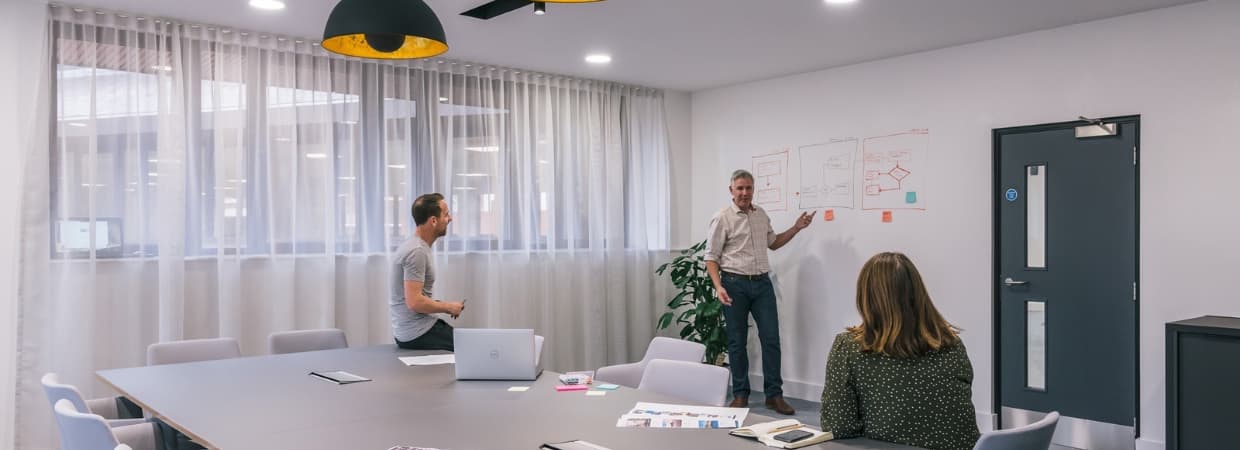
Office management has always been about organisation, coordination and control. It ensures that people, processes and resources work together effectively to support the day-to-day running of a business.
While the fundamentals remain the same, the role of office management has evolved. Today, it extends beyond administration to shape how the workplace supports productivity, collaboration, and the employee experience.
As working patterns change and expectations shift, office management is no longer just operational. It plays an important role in how businesses perform and grow.
At its foundation, office management is responsible for maintaining structure and efficiency in the workplace.
This includes:
These responsibilities remain essential, regardless of the size or type of organisation.
While office management has evolved, its core elements still centre on people, tools, the environment, and communication.
An office manager must ensure the right people are in place to carry out the required tasks.
This involves:
Beyond this, there is now a greater focus on understanding how teams work and how different roles interact within the workplace.
Providing the right tools is essential for efficient working.
This includes both physical and digital resources, such as:
Office management also involves monitoring usage to ensure resources are used efficiently without unnecessary cost.
The office environment has a direct impact on productivity and wellbeing.
Key considerations include:
A maintained and thoughtfully planned environment helps employees work more comfortably and efficiently.
An effective office is not just a collection of individuals. It is a group of people working towards a shared goal.
Office management plays a key role in ensuring:
Creating cohesion across the workplace improves both efficiency and morale.
Clear communication is essential for any business to operate effectively.
Office management must ensure that:
While modern technology has made communication faster, it must still be managed carefully to avoid distraction and maintain focus.
While these core responsibilities remain, the expectations placed on office management have grown.
Today, office managers are also involved in:
This reflects a broader shift in how organisations view the workplace.
The physical workspace is no longer just a backdrop to office activity. It plays an active role in how people work.
Layout, design and functionality all influence behaviour.
For example:
An environment supports office management responsibilities by making it easier for teams to work effectively.
Hybrid working has added a new layer to office management.
With employees working across multiple locations, managing occupancy, communication and collaboration requires a more flexible approach.
This includes:
Office management now extends beyond the physical office into the wider working environment.
Efficient use of space remains a key priority.
However, this is no longer about fitting as many desks as possible into a space. It is about ensuring the space supports how people actually work.
This may involve:
Balancing efficiency with employee experience is essential.
Effective office management depends on more than processes and people. The workplace itself plays a key role in how efficiently teams operate.
The way a space is planned and delivered can either support or hinder communication, collaboration and day-to-day workflows. A considered layout, supported by the right furniture and technology, makes it easier for teams to work effectively and for office management to maintain structure and efficiency.
Our commercial interior designers at COEL work closely with organisations to ensure that workplace design aligns with operational needs. By bringing together planning, design, build and furniture, we create environments that support both the day-to-day responsibilities of office management and the wider goals of the business.
By aligning workplace design with how teams operate, organisations can create spaces that improve productivity, support communication and enable success.
Prefer an AI Summary?